
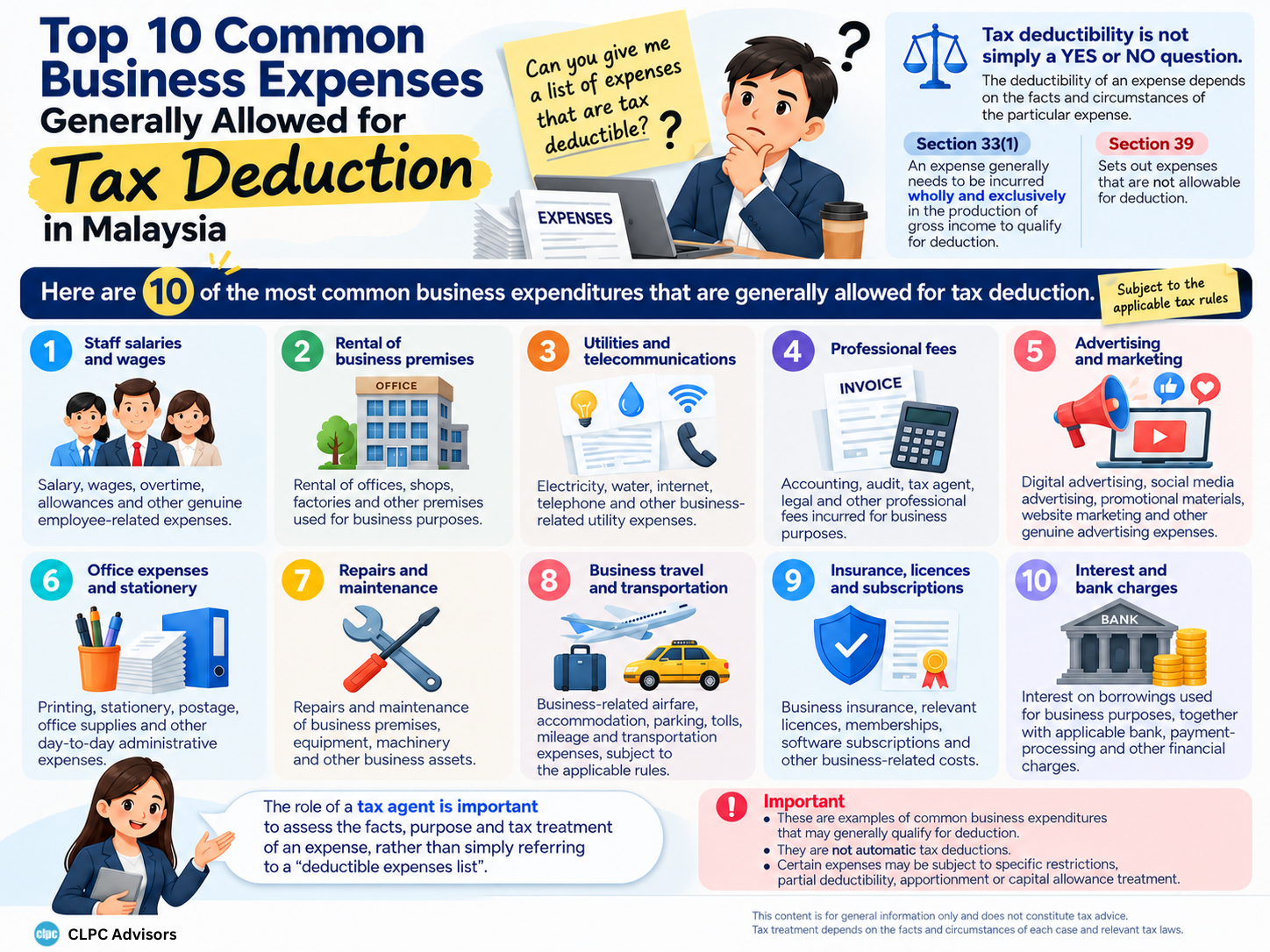
 Top 10 Common Business Expenses Generally Allowed for Tax Deduction in Malaysia
“Can you give me a list of expenses that are tax deductible?”
This is one of the most common questions asked by business owners.
However, tax deductibility is not simply a YES or NO question.
The deductibility of an expense depends on the facts and circumstances of the particular expense.
Under Section 33(1) of the Income Tax Act 1967, an expense generally needs to be incurred wholly and exclusively in the production of gross income to qualify for deduction.
At the same time, Section 39 sets out expenses that are not allowable for deduction.
Therefore, an expense cannot become tax deductible simply because:
❌ The company paid for it
❌ It was paid using the company credit card
❌ There is a receipt
❌ It is recorded in the company accounts
This is one of the reasons why the role of a tax agent is important — to assess the facts, purpose and tax treatment of an expense rather than simply referring to a “deductible expenses list”.
That said, here are 10 of the most common business expenditures that are generally allowed for tax deduction, subject to the applicable tax rules:
1. Staff salaries and wages
Salary, wages, overtime, allowances and other genuine employee-related expenses.
2. Rental of business premises
Rental of offices, shops, factories and other premises used for business purposes.
3. Utilities and telecommunications
Electricity, water, internet, telephone and other business-related utility expenses.
4. Professional fees
Accounting, audit, tax agent, legal and other professional fees incurred for business purposes.
5. Advertising and marketing
Digital advertising, social media advertising, promotional materials, website marketing and other genuine advertising expenses.
6. Office expenses and stationery
Printing, stationery, postage, office supplies and other day-to-day administrative expenses.
7. Repairs and maintenance
Repairs and maintenance of business premises, equipment, machinery and other business assets.
8. Business travel and transportation
Business-related airfare, accommodation, parking, tolls, mileage and transportation expenses, subject to the applicable rules.
9. Insurance, licences and business subscriptions
Business insurance, relevant licences, memberships, software subscriptions and other business-related costs.
10. Interest and bank charges
Interest on borrowings used for business purposes, together with applicable bank, payment-processing and other financial charges.
⚠️ Important: These are examples of common business expenditures that may generally qualify for deduction. They are not automatic tax deductions.
Certain expenses may be subject to specific restrictions, partial deductibility, apportionment or capital allowance treatment.
So, instead of asking:
“Is this expense on the tax-deductible list?”
Ask:
“Was this expense incurred wholly and exclusively in the production of my business income, and is it prohibited or restricted under the tax rules?”
That is where proper tax advice matters.
Tax deduction is about the facts behind the expense — not simply the name of the expense or the method of payment.
Conclusion
Tax deduction is not simply about whether an expense appears on a “deductible expenses list”.
The tax treatment depends on the facts, purpose and circumstances of each expense, together with the applicable provisions of the Income Tax Act 1967, Public Ruling, LHDN Guideline and relevant case law.
To understand Business Expenses You Cannot Claim as Tax Deduction in Malaysia: Understanding Section 39, Click the below link:
https://clpc.my/non-deductible-business-expenses-malaysia/
How CLPC Advisors Can Help
CLPC Advisors can help your business with:
- Tax deduction review and advice
- Tax computation and tax filing
- Tax planning and advisory
- Review of business expenses and supporting documents
- Advice on capital expenditure and capital allowance
- Tax compliance and LHDN matters
Don’t just ask “Can I claim this?” — understand why and how it can be claimed.
Prepared & Reviewed By
Pang Cheng Leong is the Managing Director of CLPC Advisors Sdn Bhd, a professional services firm in Malaysia providing corporate tax, accounting, corporate secretarial and business advisory services.
He is a Chartered Accountant in Malaysia, Chartered Tax Practitioner, Licensed Income Tax Agent under Section 153 Income Tax Act Malaysia and Licensed Company Secretary, and has extensive experience advising Malaysian companies, startups and foreign investors on taxation, compliance and business structuring.
Professional affiliations: CA (Malaysia), CPA (Australia), CPA (Malaysia), ASEAN CPA, ACTIM
Disclaimer
Disclaimer: This content is provided for general information purposes only and does not constitute tax or professional advice. Tax treatment depends on the specific facts and circumstances of each case and the applicable laws, regulations and guidelines in force at the relevant time. Professional advice should be obtained before making tax claims or decisions.