
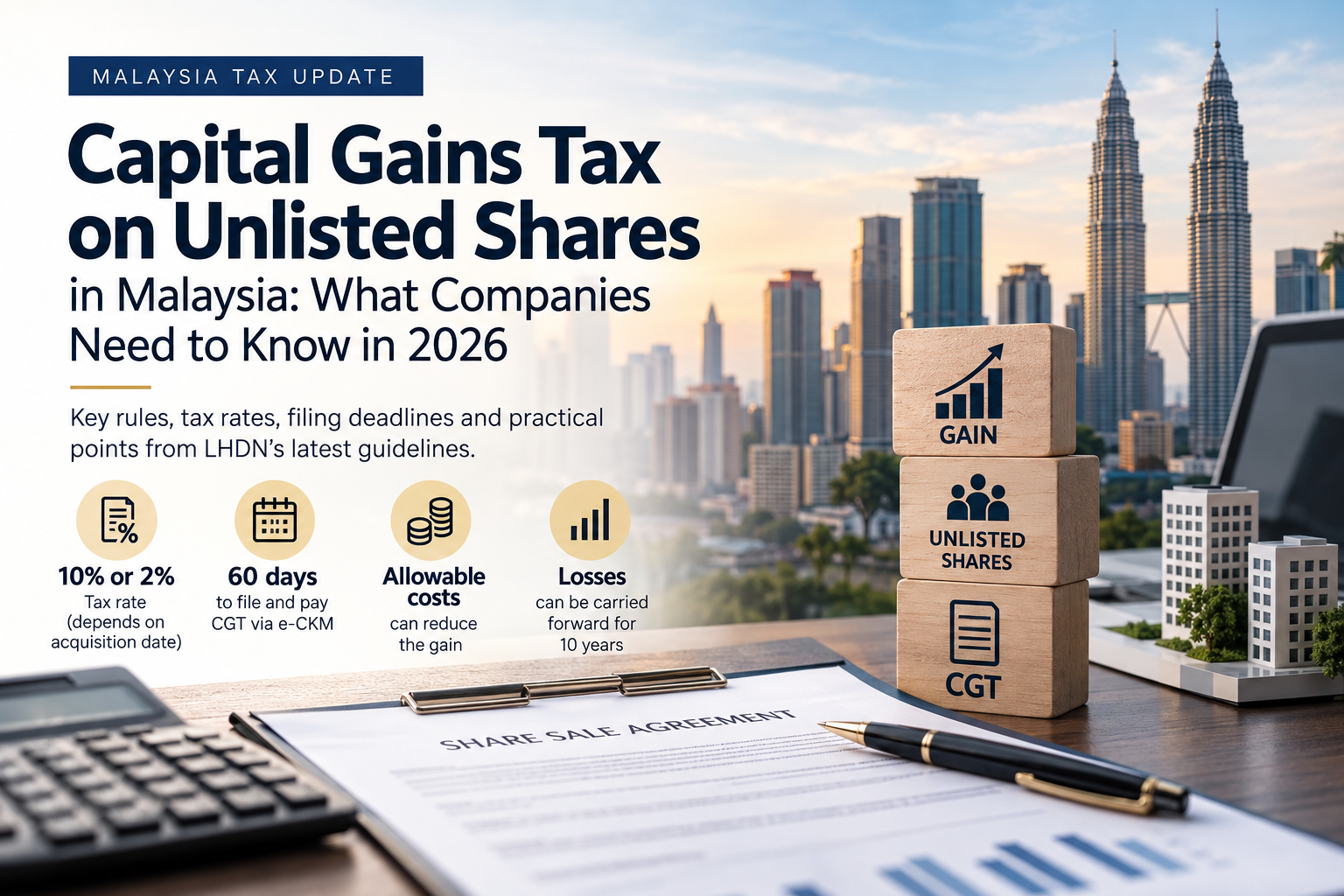
Capital Gains Tax on Unlisted Shares in Malaysia: What Companies Need to Know in 2026
The disposal of shares in a private company may no longer be simply a corporate transaction with accounting and legal considerations.
Since the introduction of Capital Gains Tax (CGT), certain gains from the disposal of capital assets are subject to tax under the Income Tax Act 1967.
LHDN has now issued an updated Guidelines on Capital Gains Tax for Unlisted Shares dated 21 September 2026, replacing the previous guideline dated 21 July 2025.
The updated guideline provides further clarification on the scope of CGT, disposal dates, market valuation, allowable costs, capital losses, relevant company shares and CGT reporting requirements.
So, if your company is planning to sell shares in a private company, what should you know before completing the transaction?
1. What is Capital Gains Tax on Unlisted Shares?
Malaysia introduced CGT through the Finance (No. 2) Act 2023.
For unlisted shares, CGT generally applies to gains or profits arising from the disposal of shares in an unlisted company incorporated in Malaysia.
The CGT framework also covers certain shares in controlled foreign companies that fall within the definition of a relevant company under section 15C of the Income Tax Act 1967.
The CGT provisions took effect from 1 January 2024, with the implementation of CGT on capital assets commencing from 1 March 2024.
2. Who is Subject to CGT?
The CGT provisions covered by these guidelines apply to certain entities, including:
- Companies
- Limited liability partnerships
- Trust bodies
- Co-operative societies
- Labuan entities subject to tax under the Income Tax Act
Therefore, the CGT rules for unlisted shares are particularly relevant to companies holding investments in private companies.
What about individual shareholders?
This particular guideline is focused on the CGT treatment of the capital assets held by the entities specified above. The tax treatment of an individual shareholder should be considered separately based on the applicable provisions and circumstances.
3. What Counts as an Unlisted Share?
The guideline covers shares in a company incorporated in Malaysia that are not listed on a stock exchange.
The scope can include equity-type instruments such as ordinary shares and preference shares, as well as certain convertible bonds or long-term borrowings that are equity in nature.
Therefore, businesses should not assume that CGT applies only to a straightforward sale of ordinary shares.
4. When is a Share Disposal Considered to Have Taken Place?
This is one of the most important practical issues.
Where there is a written agreement, the disposal date is generally the date of the agreement.
For example:
Company A signs a share sale agreement on 1 October 2026, but the shares are transferred and payment is completed on 1 December 2026.
Under the guideline, the disposal date may be 1 October 2026, being the date of the written agreement.
This means the 60-day CGT reporting and payment period can start much earlier than the actual share transfer date.
For transactions without a written agreement, the rules determine the disposal date based on completion and other relevant events.
Practical takeaway
Do not wait until the share transfer is completed before considering the CGT filing deadline.
The share sale agreement itself may determine the disposal date.
5. How is the Capital Gain Calculated?
In general, the gain is determined by comparing the disposal price with the acquisition price, after taking into account qualifying expenditure.
A simplified illustration is:
Disposal consideration
Less: Allowable disposal costs
= Disposal price
Acquisition consideration
Add: Allowable acquisition costs
= Acquisition price
Disposal price – Acquisition price = Adjusted gain / loss
The guideline provides specific rules on what expenditure can be taken into account.
6. What Expenses Can Be Deducted?
Certain costs directly connected with the acquisition or disposal may qualify.
Examples include:
Disposal costs
- Legal fees
- Valuation fees
- Agent’s commission
- Advertising costs to find a buyer
- Certain valuation-related costs
Acquisition costs
- Legal fees
- Valuation fees
- Agent’s commission
- Stamp duty
- Transfer costs
- Advertising costs to find a seller
These costs must generally meet the requirements specified in the CGT provisions.
Important: The normal tax deductions under sections 33 and 34 of the ITA do not automatically apply when calculating gains from disposal of capital assets.
7. What Happens If Shares Are Sold Below Market Value?
This is particularly important for related-party transactions.
For certain transactions, the consideration may be deemed to be equal to the market value of the shares.
This can apply where, among other circumstances, the transaction:
- Is not conducted at arm’s length;
- Is between connected persons;
- Involves a gift;
- Involves consideration that cannot be properly valued; or
- Falls within other specified circumstances under the ITA.
Therefore:
Selling shares to a related company for RM1 does not necessarily mean the CGT calculation is based on RM1.
The market value rules need to be considered.
8. How Do You Determine the Market Value of Private Company Shares?
Because unlisted shares do not have a quoted market price, valuation can become an important issue.
The guideline states that an appropriate valuation method may be used.
One method specifically illustrated by LHDN is the Net Tangible Assets (NTA) method.
The guideline provides the following formula:
NTA = Total Assets – Intangible Assets – Total Liabilities
Then:
NTA per share = NTA ÷ Total number of shares issued
However, the appropriate valuation approach will depend on the circumstances of the company and transaction.
9. What If the Company Makes a Capital Loss?
CGT does not simply mean that every disposal creates a tax liability.
Where the disposal price is lower than the acquisition price, an adjusted loss may arise.
The guideline allows an adjusted loss from one disposal to be used against adjusted income from subsequent disposals of capital assets, subject to the applicable rules.
Unabsorbed current-year losses can generally be carried forward for 10 consecutive years of assessment.
Any remaining balance after the 10-year period is disregarded.
Example
Suppose a company has:
- Loss from Disposal A: RM300,000
- Gain from Disposal B: RM200,000
The current-year loss may be used against the gain, subject to the applicable CGT rules.
The remaining RM100,000 loss may then potentially be carried forward.
10. The 10% vs 2% Rule — Why the Acquisition Date Matters
This is one of the most important areas for companies that have held shares for many years.
Shares acquired before 1 January 2024
The taxpayer may choose between:
Option 1:
10% of chargeable income
Option 2:
2% of gross disposal price
Shares acquired on or after 1 January 2024
The applicable rate is:
10% of chargeable income
Simple illustration
Suppose old shares acquired before 1 January 2024 are sold for:
RM5 million
If the company chooses the 2% gross disposal price method:
RM5,000,000 × 2% = RM100,000
Under the 10% chargeable-income method, the tax would depend on the chargeable gain after the applicable CGT computation.
Therefore, the acquisition date and historical records of the shares are extremely important.
Companies should maintain proper documentation showing when and how the shares were originally acquired.
11. Foreign Companies Can Also Fall Within the CGT Rules
CGT is not necessarily limited to shares in Malaysian companies.
Section 15C can apply to shares in certain controlled companies incorporated outside Malaysia where the company owns Malaysian real property or shares in another controlled company meeting the prescribed conditions.
A key test is the 75% threshold based on defined value compared with total tangible assets.
For example, the updated guideline illustrates how a foreign company can become a relevant company after subsequently acquiring Malaysian property or qualifying shares.
The status can therefore change over time.
This is particularly relevant for group structures involving Malaysian property, offshore holding companies and cross-border investments.
12. What About Real Property Companies (RPC)?
The updated guideline confirms that gains from the disposal of RPC shares by entities subject to the ITA are dealt with under the CGT framework rather than RPGT.
This includes relevant RPC shareholdings held before 1 January 2024 in the circumstances specified by the guideline.
This means companies should carefully review the tax treatment before disposing of shares in a company whose underlying assets consist substantially of Malaysian real property.
13. CGT Return Must Be Filed Within 60 Days
This is probably the deadline that shareholders and directors should remember.
The guideline states that the taxpayer must submit the CGT return through e-Filing using the e-CKM Form within 60 days from the date of disposal.
The CGT must also be paid within 60 days from the disposal date.
There is also no requirement to submit estimated tax payable under section 107C or pay CGT through instalments.
In practice:
Share Sale Agreement signed → Determine disposal date → Calculate CGT → File e-CKM → Pay CGT
Do not wait until the company’s normal income tax return deadline.
14. What Should a Company Prepare Before Selling Its Shares?
Before entering into a share disposal, companies should consider preparing the following:
✅ 1. Original acquisition documents
Keep the SPA, subscription documents, share certificates and other evidence of acquisition.
✅ 2. Acquisition cost records
Determine the original acquisition price and qualifying incidental costs.
✅ 3. Disposal agreement
The date of the agreement may determine the CGT disposal date.
✅ 4. Valuation
Consider whether a market valuation is required, particularly for related-party transactions.
✅ 5. Disposal expenses
Keep legal fees, valuation fees, commission and other relevant supporting documents.
✅ 6. Historical CGT losses
Check whether there are unabsorbed capital losses available from previous disposals.
✅ 7. Acquisition date
Determine whether the shares were acquired before or after 1 January 2024, as this affects the applicable tax rate.
✅ 8. Filing deadline
Mark the 60-day deadline from the disposal date.
Conclusion
The disposal of shares in a private company is no longer simply a matter of agreeing on a selling price and completing the share transfer.
For companies subject to CGT, the transaction requires consideration of:
Disposal date + acquisition date + valuation + allowable costs + capital losses + applicable CGT rate + 60-day filing deadline.
The latest LHDN guideline dated 21 September 2026 provides detailed clarification on these areas and replaces the previous 2025 guideline.
If your company is planning to dispose of shares in a Malaysian private company, particularly where the transaction involves related parties, group restructuring, foreign companies or significant shareholdings, the CGT implications should be reviewed before the transaction is completed.
About CLPC Advisors
CLPC Advisors provides tax, accounting, corporate advisory, Corporate Secretarial and compliance services to Malaysian businesses.
Our team assists companies with tax compliance, tax advisory, corporate restructuring and transaction-related tax considerations.
Tax | Advisory | Accounting
This article is for general information and is based primarily on the LHDN Guidelines on Capital Gains Tax for Unlisted Shares dated 21 September 2026. The actual CGT treatment depends on the specific facts and applicable provisions of the Income Tax Act 1967. Professional advice should be obtained for specific transactions.
Prepared & Reviewed By:
Pang Cheng Leong is the Managing Director of CLPC Advisors Sdn Bhd, a professional services firm in Malaysia providing corporate tax, accounting, corporate secretarial and business advisory services.
He is a Chartered Accountant in Malaysia, Chartered Tax Practitioner, Licensed Income Tax Agent under Section 153 Income Tax Act Malaysia and Licensed Company Secretary, and has extensive experience advising Malaysian companies, startups and foreign investors on taxation, compliance and business structuring.
Professional affiliations: CA (Malaysia), CPA (Australia), CPA (Malaysia), ASEAN CPA, ACTIM