
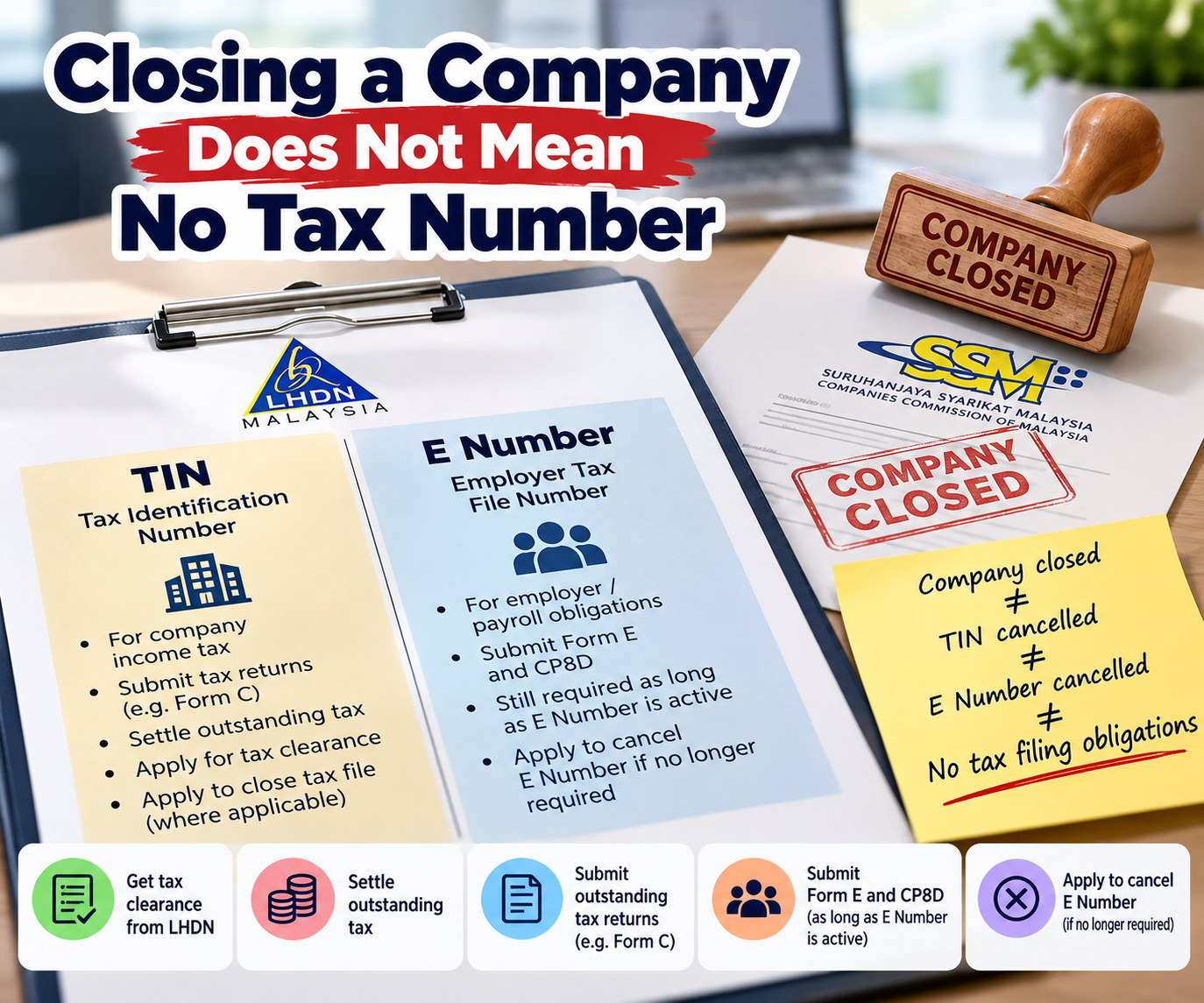
 Closing a Company Does Not Automatically Cancel Its LHDN Tax Numbers
Many business owners assume that once a company has been closed, struck off, or has ceased business operations, all of its tax obligations with LHDN automatically come to an end.
This is not necessarily the case.
Closing a company with SSM does not automatically mean that its LHDN tax registrations are cancelled.
In particular, it is important to understand the difference between the company’s Tax Identification Number (TIN) and its E Number.
TIN vs E Number — What Is the Difference?
1. TIN — Tax Identification Number (also known as C number)
The TIN identifies the taxpayer for income tax purposes. For Private Limited Company (Sdn Bhd) in Malaysia also known as C number.
For a company, the TIN is associated with its corporate income tax file and tax compliance obligations with LHDN.
Even after a company has stopped operating or has been closed with SSM, the company’s tax affairs may still need to be finalised with LHDN.
This may include:
- Filing outstanding income tax returns;
- Paying outstanding income tax or other tax liabilities;
- Resolving outstanding tax queries or assessments;
- Applying for tax clearance; and
- Applying to close the company’s income tax file, where applicable.
Closing the company with SSM does not automatically cancel or close its TIN/tax file with LHDN.
2. E Number — Employer Tax File Number
The E Number is different from the company’s TIN.
An E Number relates to the company’s employer/payroll tax obligations, including employer reporting requirements.
If the company has an active E Number with LHDN, the company may continue to have employer filing obligations even after it has ceased business.
For example, where applicable, the company may still need to submit Form E and CP8D for the relevant year.
Therefore, simply closing the company or stopping employment activities does not mean that the E Number is automatically cancelled.
If the company no longer requires its E Number, it should apply to LHDN for cancellation of the E Number.
A Simple Way to Remember
Think of the two registrations separately:
| Registration | What does it relate to? | What needs to be done when closing? |
|---|---|---|
| TIN (C Number) | Company’s income tax | Finalise tax returns, settle outstanding tax and apply for tax file closure/tax clearance where applicable |
| E Number | Employer/payroll obligations | Ensure outstanding Form E/CP8D obligations are fulfilled and apply to LHDN to cancel the E Number if no longer required |
TIN (C number) and E Number are separate registrations and should not be treated as one.
Why Is This Important?
A company can stop operating but still have outstanding LHDN obligations.
For example, a company may have:
- Closed its business;
- Stopped employing staff;
- Applied for strike-off with SSM; or
- Already been struck off,
while its TIN and/or E Number may still remain active in LHDN’s records.
This is why business owners should not assume that closing the company automatically ends all tax filing obligations.
In particular:
If the E Number remains active, do not simply stop submitting Form E.
The company should first ensure that its outstanding employer obligations are dealt with and apply to LHDN to cancel the E Number if it is no longer required.
Likewise, the company’s income tax file/TIN should be properly dealt with separately.
Appoint a Tax Agent to Handle the Process
The tax closure process can involve several steps, and dealing with SSM alone may not be sufficient.
A tax agent can assist with:
- Reviewing the company’s TIN and E Number status;
- Checking outstanding income tax returns and tax balances;
- Preparing and submitting outstanding tax returns;
- Filing outstanding Form E and CP8D, where applicable;
- Applying for tax clearance;
- Applying to LHDN to cancel the E Number, where applicable;
- Applying for closure of the company’s income tax file, where applicable; and
- Following up with LHDN until the company’s tax matters and registrations are properly regularised.
In Short
SSM company closure ≠ LHDN tax closure
TIN ≠ E Number
TIN → Corporate income tax obligations
E Number → Employer/payroll obligations
E Number still active → Form E obligations may continue
No longer need E Number → Apply to LHDN for cancellation
Closing a company is therefore not simply a matter of stopping operations or completing the SSM process. The company’s LHDN tax affairs must also be properly finalised.
If you are planning to close or strike off a Malaysian company, consider appointing a tax agent to review the TIN and E Number, settle outstanding filings and tax, and handle the necessary applications with LHDN.
Conclusion
Closing a company does not automatically bring its LHDN tax obligations to an end.
It is important to distinguish between the TIN (C number), which relates to the company’s income tax affairs, and the E Number, which relates to employer/payroll obligations. Even after a company has ceased business or been closed with SSM, outstanding tax filings, tax payments and employer obligations may still need to be addressed.
Properly closing the company’s tax affairs with LHDN helps to avoid unnecessary compliance issues, outstanding filings and potential penalties in the future.
How CLPC Advisors Can Help
At CLPC Advisors, we assist companies with the tax compliance and closure process, including:
- Reviewing the company’s TIN (C number) and E Number status;
- Checking outstanding tax returns and tax liabilities;
- Preparing and submitting outstanding income tax returns;
- Handling outstanding Form E and CP8D submissions, where applicable;
- Handling outstanding Form C, Form PT Submission, where applicable;
- Assisting with tax clearance applications;
- Assisting with the application to cancel the C number (TIN) and E Number where it is no longer required or after company strike off;
- Assisting with the closure of the company’s income tax file with LHDN, where applicable; and
- Liaising with LHDN on outstanding tax matters and follow-ups.
If you are planning to close, strike off or cease operations of a Malaysian company, engaging a tax agent early can help ensure that the company’s tax affairs are properly dealt with.
Disclaimer
This article is provided for general information and educational purposes only and does not constitute tax, legal or professional advice.
Tax laws, regulations, administrative procedures and LHDN requirements may change from time to time. The actual tax filing and closure requirements may also vary depending on the company’s circumstances.
Readers should obtain professional advice based on their specific circumstances before taking any action. CLPC Advisors shall not be responsible for any loss or consequences arising from reliance on the information contained in this article.
Prepared and Reviewed By
This article is prepared and professionally reviewed by Pang Cheng Leong , a Malaysian Chartered Accountant, Chartered Tax Practitioner, Licensed Tax Agent Under Section 153 Income Tax Act Malaysia and Licensed Company Secretary, with professional experience in accounting, taxation, Audit and corporate compliance.
Professional affiliations: CA (Malaysia), CPA (Australia), CPA (Malaysia), ASEAN CPA), ACTIM
He is the Founder and Managing Director of CLPC Advisors, a Malaysian Accounting, Tax and Corporate Advisory firm providing accounting, tax, advisory and corporate secretarial services to businesses in Malaysia.