
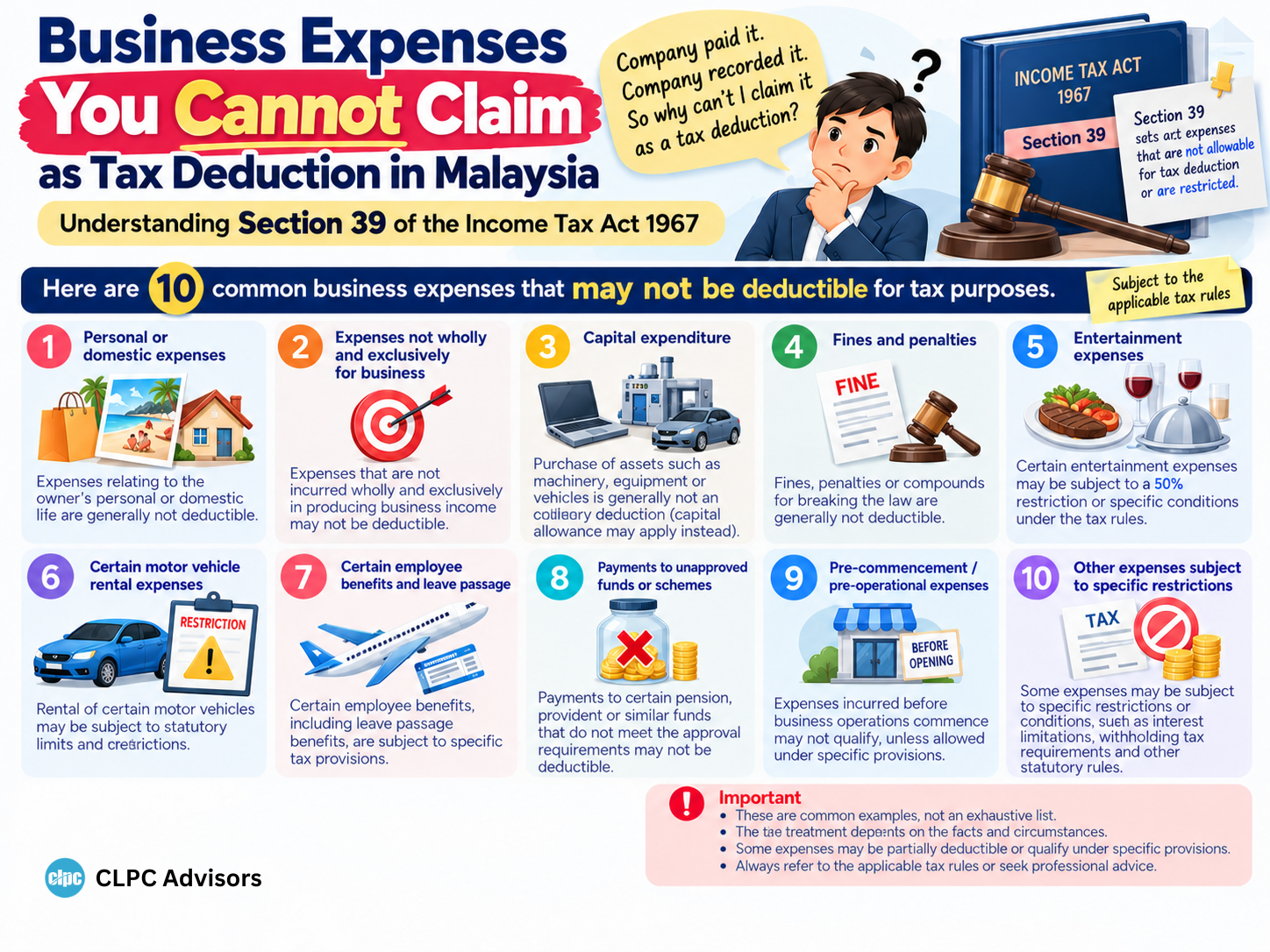
 Business Expenses You Cannot Claim as Tax Deduction in Malaysia: Understanding Section 39
“My company paid for it and recorded it as an expense. Why can’t I claim it as a tax deduction?”
This is a common question among business owners.
Many business owners assume that if an expense is recorded in the company’s accounts, it automatically reduces taxable income.
It doesn’t.
For Malaysian income tax purposes, accounting treatment and tax treatment are not necessarily the same.
Generally, Section 33(1) of the Income Tax Act 1967 allows a deduction for expenses incurred wholly and exclusively in the production of gross income. However, this general deduction rule must be read together with Section 39, which specifically sets out expenses for which deductions are not allowed or are restricted.
What is Section 39 of the Income Tax Act 1967?
Section 39 – Deductions Not Allowed deals with expenses that cannot be deducted when determining the adjusted income of a business source.
In simple terms:
An expense may appear in your accounting profit and loss statement, but it may still need to be added back in your tax computation.
Section 39 specifically identifies expenditure that is not allowable as a deduction from the gross income of a source.
Therefore, business owners should not look at an expense only from an accounting perspective.
They should also ask:
“Is this expense deductible for tax purposes?”
Common Business Expenses That May Not Be Deductible
Below are some common examples business owners should be aware of.
1. Personal or Domestic Expenses
Expenses relating to the owner’s personal or domestic life are generally not deductible.
For example:
- Personal groceries
- Family holidays
- Personal clothing
- Private household expenses
- Personal entertainment
Calling the expense a “business expense” or paying it through the company does not automatically make it deductible.
Section 39 specifically refers to domestic or private expenses as non-deductible.
2. Expenses Not Wholly and Exclusively for Business
An expense must generally be incurred wholly and exclusively in producing the business’s gross income.
For example, if a particular expense has both business and private elements, the entire amount may not necessarily qualify for deduction.
This is why the purpose and facts behind the expenditure matter.
The tax treatment cannot always be determined simply from the description appearing in the accounting ledger.
3. Capital Expenditure
Capital expenditure is another important area.
For example:
- Purchase of machinery
- Purchase of equipment
- Acquisition of certain business assets
- Capital improvements
Generally, capital expenditure is not treated as an ordinary revenue expense deduction.
Instead, where applicable, tax relief may be available through capital allowances or other specific provisions.
The depreciation of assets is not deductible and that capital allowances provide the tax deduction mechanism for qualifying assets used in a business.
So:
Accounting depreciation ≠ tax deduction
and
Capital expenditure ≠ automatically deductible as a business expense.
4. Fines and Penalties
Business owners may incur various fines, penalties or compounds.
However, an expense being incurred in the course of running a business does not automatically mean it is tax deductible.
The tax treatment needs to be considered based on the nature of the payment and the relevant provisions.
This is another example where simply recording the amount under “business expenses” does not settle the tax treatment.
5. Entertainment Expenses
Entertainment is a particularly important example because the answer is not simply “deductible” or “non-deductible.”
Certain entertainment expenditure may be subject to a 50% restriction, while specific categories can qualify for different treatment under the tax rules.
This means business owners should not assume:
“It was a business dinner, therefore 100% deductible.”
The actual purpose, recipient and circumstances need to be considered.
Section 39 contains specific provisions dealing with entertainment expenditure and restrictions.
6. Certain Motor Vehicle Rental Expenses
Section 39 contains specific restrictions concerning deductions for rental of certain motor vehicles.
Therefore, simply categorising a vehicle-related payment as “business transportation” does not necessarily mean the entire amount is deductible.
The applicable statutory limits and conditions need to be considered.
Business use does not automatically mean the full vehicle rental expense is tax deductible.
For non-commercial motor vehicles, the rental deduction is generally restricted to:
- RM50,000 per vehicle; or
- RM100,000 if the vehicle is brand new, has not been previously used, and its cost does not exceed RM150,000.
Commercial vehicles licensed for the transportation of goods or passengers are subject to different treatment.
Example: If annual rental is RM60,000 and the RM50,000 limit applies, only RM50,000 may qualify for deduction, subject to the applicable tax rules.
7. Certain Employee Benefits and Leave Passage
Certain employee benefits may have specific tax treatment.
For example, Section 39 contains provisions dealing with expenditure relating to leave passage benefits.
This is another area where business owners should not assume that every employee-related expenditure is automatically fully deductible.
8. Certain Payments to Unapproved Funds or Schemes
Section 39 also contains restrictions relating to payments made to certain pension, provident, savings and similar funds that do not meet the relevant approval requirements.
Therefore, the fact that an amount relates to employees does not by itself determine whether the expenditure is deductible.
9. Pre-Commencement / Pre-Operational Expenses
Expenses incurred before a business actually commences operations require particular attention.
As a general principle, pre-operational expenditure may not qualify under the ordinary deduction rule because it may not have been incurred wholly and exclusively in producing the business income at that time.
However, specific provisions may allow certain qualifying pre-operational expenses.
Certain pre-operational expenses can be allowed under Schedule 4B, specific provisions, rules or Ministerial orders.
Therefore:
“Pre-operational” does not automatically mean “100% non-deductible”.
The specific nature of the expenditure must be examined.
10. Other Expenses Subject to Specific Tax Restrictions
Some expenses may satisfy the general business-purpose test but still be subject to specific tax restrictions or conditions.
Examples can include:
- Interest expense subject to specific limitation rules
- Entertainment restrictions
- Motor vehicle rental restrictions
- Certain payments subject to withholding-tax requirements
- Expenses subject to specific statutory conditions
For example, interest deductibility can also be subject to Section 140C and the related interest restriction rules, depending on the circumstances.
This illustrates why Section 39 should not be viewed as a simple “blacklist”.
Accounting Expense Does Not Equal Tax Deduction
This is perhaps the most important lesson for business owners.
Imagine a company has:
Accounting profit before tax: RM500,000
The accounts include RM50,000 of expenses that are not deductible for tax purposes.
The company cannot simply assume that:
RM500,000 – RM50,000 = RM450,000 taxable income
The non-deductible amount may need to be added back in the tax computation, subject to the applicable tax treatment.
The tax computation therefore reconciles accounting results to the amount subject to tax.
Section 33 vs Section 39 — How Do They Work Together?
A simple way to understand the relationship is:
Section 33(1)
Is the expense incurred wholly and exclusively in producing gross income?
⬇️
Section 39
Is there a specific provision prohibiting or restricting the deduction?
⬇️
Other specific provisions
Is there another provision providing a special deduction, capital allowance, restriction or different tax treatment?
⬇️
Tax computation
Determine the appropriate tax treatment.
HASiL confirms that Section 33(1) should be read together with Section 39(1) when determining adjusted income.
Why a “Tax Deductible Expenses List” Is Not Enough
This is why we often caution business owners against relying on a simple checklist.
For example:
Entertainment
❌ “Entertainment = non-deductible.”
Not necessarily.
Motor vehicle expense
❌ “Used for business = fully deductible.”
Not necessarily.
Asset purchase
❌ “Used by the business = ordinary tax deduction.”
Not necessarily.
Employee expense
❌ “Employee-related = automatically deductible.”
Not necessarily.
The facts and circumstances matter.
To Understand what is the top 10 business expenses that allowable for Tax deduction, click below link:
https://clpc.my/top-10-common-business-expenses-generally-allowed-for-tax-deduction-in-malaysia/
What Can CLPC Advisors Help With?
At CLPC Advisors, we help businesses understand the difference between accounting expenses and tax-deductible expenses.
Our tax advisory and compliance services can include:
- Review of business expenses for tax purposes
- Tax computation and tax filing
- Identification of potential tax add-backs
- Capital allowance computation
- Tax planning
- Tax treatment of business transactions
- Tax advisory on specific expenditure
- LHDN tax compliance and advisory matters
The objective is not simply to “claim as much as possible.”
It is to ensure that the business claims what it is legitimately entitled to claim under the applicable tax rules.
Conclusion
There is no simple rule that says:
“If the company paid for it, it is tax deductible.”
Likewise, Section 39 should not be viewed as merely a list of expenses that businesses can never claim.
The correct tax treatment depends on:
Purpose + facts + supporting documents + Section 33 + Section 39 + other applicable tax provisions.
This is why tax deductibility is not always a straightforward YES or NO question.
A properly recorded accounting expense may require a tax adjustment, may be partially deductible, or may qualify for a different form of tax relief such as capital allowance.
When in doubt, don’t simply ask “Can I claim this?”
Ask:
“What is the tax treatment of this expense based on the facts of my business?”
That is where professional tax advice can make a difference.
Prepared & Reviewed By
Pang Cheng Leong is the Managing Director of CLPC Advisors Sdn Bhd, a professional services firm in Malaysia providing corporate tax, accounting, corporate secretarial and business advisory services.
He is a Chartered Accountant in Malaysia, Chartered Tax Practitioner, Licensed Income Tax Agent under Section 153 Income Tax Act Malaysia and Licensed Company Secretary, and has extensive experience advising Malaysian companies, startups and foreign investors on taxation, compliance and business structuring.
Professional affiliations: CA (Malaysia), CPA (Australia), CPA (Malaysia), ASEAN CPA, ACTIM
Disclaimer
This article is provided for general information purposes only and does not constitute tax, accounting or professional advice. The tax treatment of an expense depends on the specific facts and circumstances and the applicable laws, regulations, public rulings and guidelines in force at the relevant time. Businesses should obtain professional advice before making tax claims or decisions.
Sources: Income Tax Act 1967 and materials published by the Inland Revenue Board of Malaysia (HASiL). LEMBAGA HASiL DALAM NEGERI MALAYSIA
Updated on 8 October 2026