
What Is the Difference Between an Audited and Unaudited Report?
One of the biggest misconceptions among business owners is that an unaudited report is simply a Balance Sheet and Profit & Loss Statement printed from the accounting system.
That is not the case.
The format and contents of a properly prepared audited and unaudited set of financial statements are generally very similar.
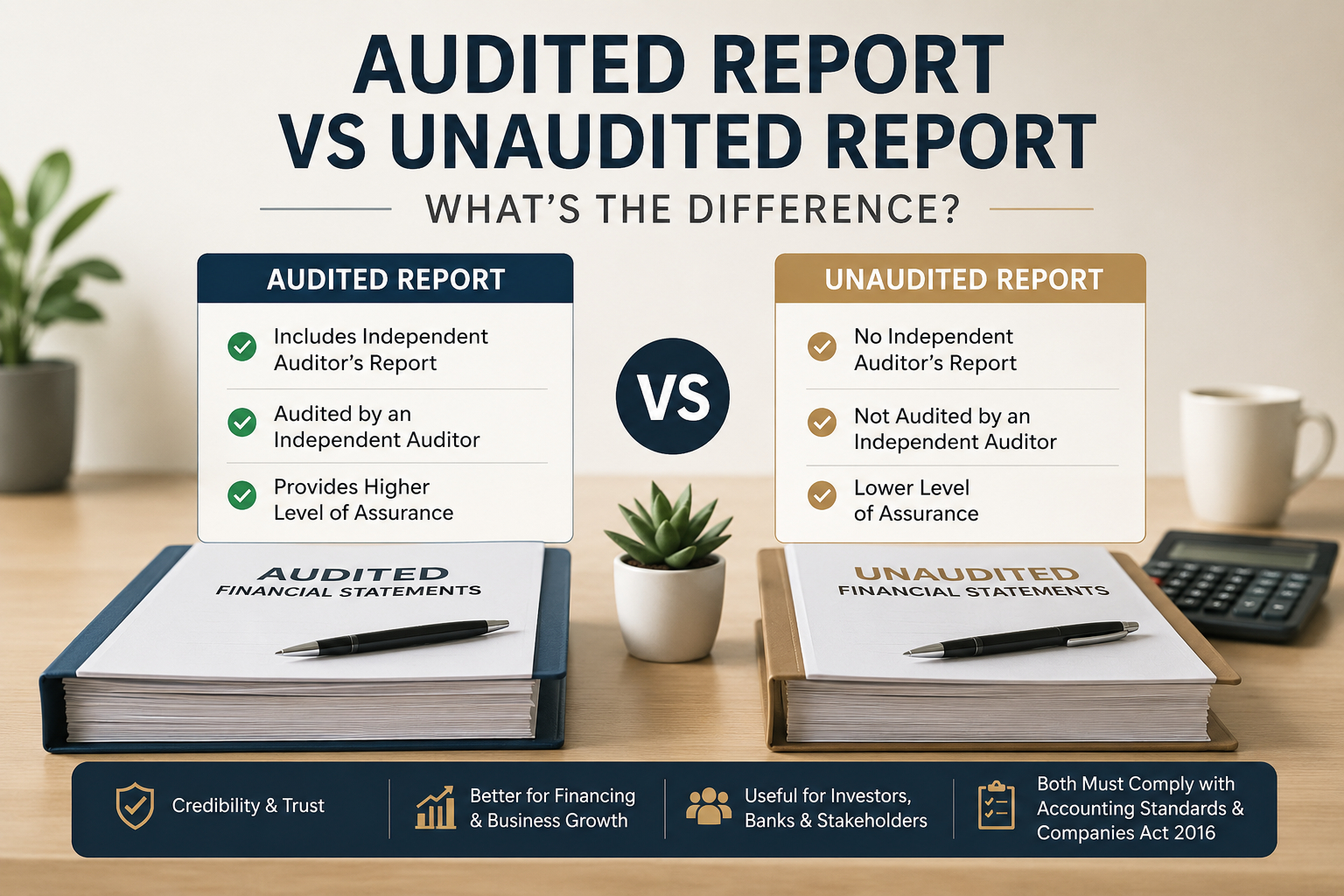
The main difference is the Independent Auditor’s Report.
Audited Financial Statements
A typical set of audited financial statements may include:
- Directors’ Report
- Statement by Directors
- Statutory Declaration
- Independent Auditor’s Report
- Statement of Comprehensive Income
- Statement of Financial Position
- Statement of Changes in Equity
- Statement of Cash Flows
- Notes to the Financial Statements
The Independent Auditor’s Report contains the auditor’s independent opinion on the financial statements.
Unaudited Financial Statements
For an unaudited set of financial statements, the company would generally still prepare the relevant components of the financial statements, including:
- Directors’ Report
- Statement by Directors
- Statutory Declaration
- Statement of Comprehensive Income
- Statement of Financial Position
- Statement of Changes in Equity
- Statement of Cash Flows
- Notes to the Financial Statements
The key difference is:
There is no Independent Auditor’s Report because the financial statements have not been audited by an independent auditor.
Therefore, it is important to understand that:
Unaudited does not mean “no financial statements”.
It simply means that the financial statements are prepared without an independent auditor’s report and audit opinion.
Audit Exemption Does Not Mean “Do Nothing”
This is particularly important for companies that qualify for audit exemption.
Some business owners may think:
“My company is exempted from audit, so I don’t need to prepare a proper set of financial statements.”
Others may think:
“I just print the Balance Sheet and Profit & Loss from my accounting software. That’s my unaudited report.”
Both assumptions can be misleading.
Audit exemption is an exemption from the audit requirement — not an exemption from preparing proper financial statements.
The financial statements still need to be properly prepared in accordance with the applicable accounting standards and comply with the relevant requirements of the Companies Act 2016.
Your accounting software can generate accounting reports, but those reports are not automatically the same thing as a complete set of statutory financial statements.
In Simple Terms
You can think of it this way:
Audited Report
Proper Financial Statements
+ Independent Auditor’s Report
Unaudited Report
Proper Financial Statements
− Independent Auditor’s Report
So, the absence of an auditor does not mean the company can skip the preparation of proper financial statements.
The financial statements still need to be properly prepared and presented. The key difference is that an independent auditor has not examined those financial statements and issued an audit opinion.
To Understand the Audit exemption requirement in Malaysia, you may click the below link:
Audit Exemption Criteria Malaysia 2026: Do I Need an Audit for My Sdn Bhd?
FAQs
1. If my company qualifies for audit exemption, can I just print the Balance Sheet and Profit & Loss from my accounting software?
No. An accounting system printout is not necessarily a complete set of statutory financial statements. The financial statements should still be properly prepared in accordance with the applicable accounting standards and relevant requirements of the Companies Act 2016.
2. Is an unaudited financial statement the same as an audited financial statement?
The financial statements themselves can have a very similar format and content. The key difference is that an unaudited set does not include the Independent Auditor’s Report and auditor’s opinion.
3. Does audit exemption mean I don’t need to prepare financial statements?
No. Audit exemption generally means the company is exempt from the audit requirement, not from its financial reporting obligations.
4. Does every small Sdn. Bhd. qualify for audit exemption?
Not necessarily. Eligibility depends on the applicable audit exemption criteria and the company’s specific circumstances.
5. Should I still voluntarily have my accounts audited if my company qualifies for audit exemption?
It depends. An audit may still be useful if the company requires bank financing, has investors or multiple shareholders, is part of a group, or needs greater independent assurance over its financial information.
6. Can I call my accounting software report an “unaudited report”?
Not automatically. A proper statutory financial statement is more than simply extracting accounting reports from software. The financial statements need to be properly prepared and presented in accordance with the applicable requirements.
Prepared & Reviewed By
Pang Cheng Leong
Chartered Accountant | Chartered Tax Practioner | Licensed Tax Agent | Licensed Company Secretary| CPA (Malaysia) | CPA (Australia) | Asean CPA | ACTIM
Managing Director, CLPC Advisors
This article has been prepared and reviewed based on the applicable accounting and corporate reporting requirements in Malaysia. Readers should consider their company’s specific circumstances and the requirements applicable to their relevant financial year.
About CLPC Advisors
CLPC Advisors is a Malaysian professional services firm providing accounting, corporate tax, tax advisory, company incorporation, corporate secretarial, payroll, and business advisory services to startups, SMEs, growing businesses and larger companies in Malaysia
Our team comprises Chartered Accountants, Licensed Tax Agents, and Licensed Company Secretaries, providing practical professional support to businesses navigating Malaysia’s accounting, tax and corporate regulatory requirements.
We believe professional advice should go beyond compliance. By understanding each client’s business and objectives, we provide practical solutions that help businesses make informed decisions and meet their statutory obligations.
How CLPC Advisors Can Help
Our accounting and audit team assists businesses with:
- Preparation of financial statements
- Unaudited financial statements
- Audit exemption assessment
- Accounting and bookkeeping
- Financial reporting
- Year-end accounts preparation
- Accounting standards and reporting requirements
- Statutory financial statement compliance
Our wider professional services include:
- Corporate income tax compliance and advisory
- CP204 tax estimates and revisions
- Form C preparation and submission
- Company incorporation
- Corporate secretarial services
- Payroll outsourcing
- Business advisory services
- Merger & Acquisition – Financial Due Diligent Audit
Audit exemption does not mean that proper financial reporting can be skipped. If you are unsure whether your Sdn Bhd requires an audit, or whether your current accounts constitute a proper set of unaudited financial statements, CLPC Advisors can help you assess your requirements.
Last Updated: 31 August 2026
Disclaimer: This article is for general informational purposes only and does not constitute professional accounting, tax, legal, or financial advice. Accounting standards, audit exemption criteria and statutory requirements may change from time to time. Businesses should seek professional advice based on their specific circumstances and the requirements applicable to their relevant financial year.