
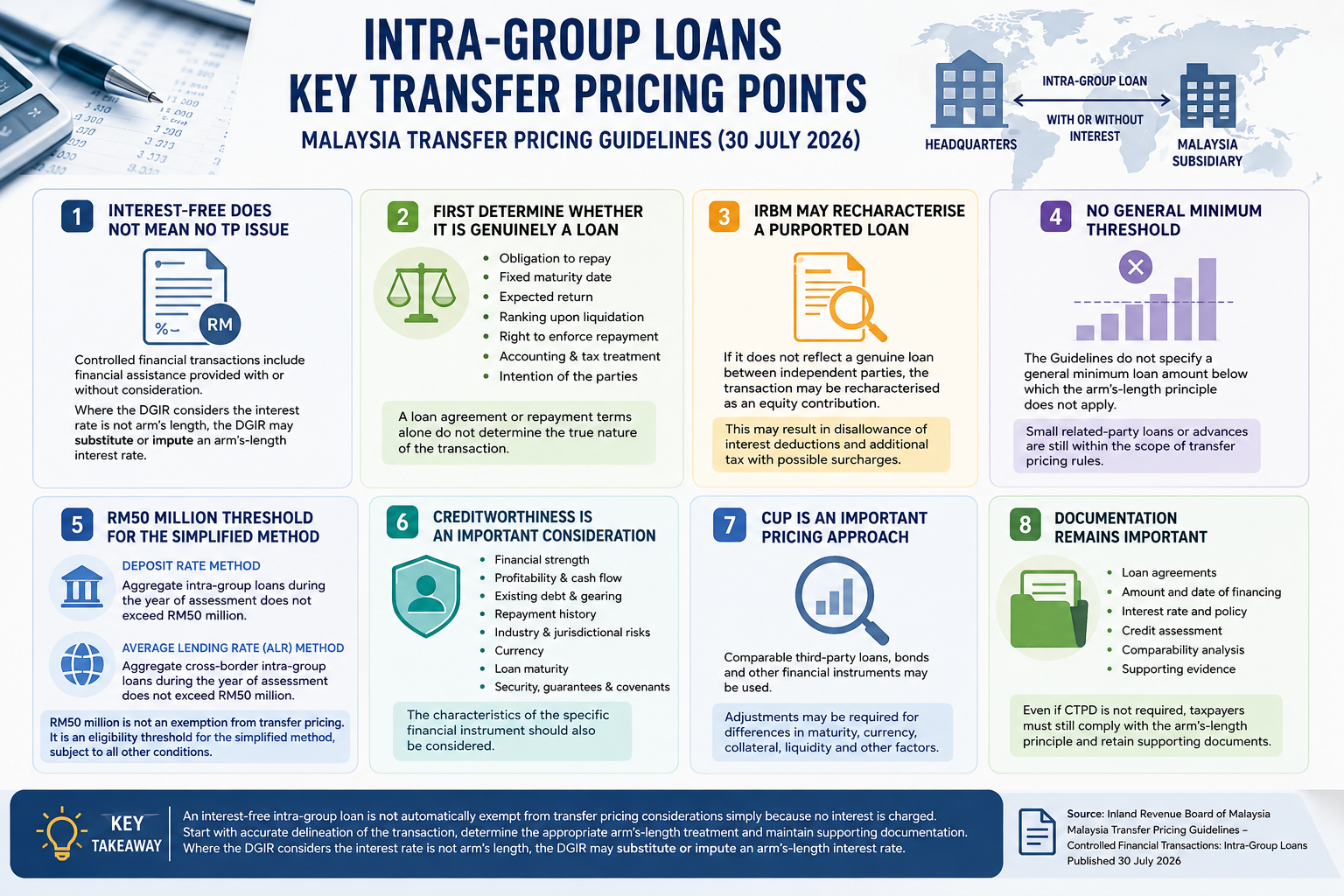
 Intra-Group Loans: Key Transfer Pricing Points Under Malaysia’s 2026 Guidelines
The Inland Revenue Board of Malaysia (IRBM) published the Malaysia Transfer Pricing Guidelines – Controlled Financial Transactions: Intra-Group Loans on 30 July 2026. The Guidelines provide specific guidance on how taxpayers should determine whether intra-group financing arrangements comply with the arm’s-length principle.
1. Interest-free does not automatically mean there is no transfer pricing issue
Controlled financial transactions include financial assistance provided with or without consideration. Therefore, an interest-free intra-group loan remains within the scope of the Guidelines.
Taxpayers should accurately delineate the transaction and determine its true nature and arm’s-length conditions. Where the DGIR considers that the interest rate of an intra-group loan is not at arm’s length, the DGIR may substitute or impute an arm’s-length interest rate.
2. First determine whether it is genuinely a loan
Before determining an arm’s-length interest rate, taxpayers should consider whether the purported loan should actually be regarded as a loan.
Relevant factors include:
- legal obligation to repay;
- fixed maturity date;
- expected return;
- ranking upon liquidation;
- right to enforce repayment;
- accounting and financial reporting treatment;
- tax treatment; and
- intention of the parties.
The existence of a formal loan agreement, fixed repayment schedule or stated interest rate does not, by itself, determine the true nature of the transaction. The overall economic substance and circumstances must be considered.
3. IRBM may recharacterise a purported loan
Where the DGIR considers that a purported loan does not reflect a genuine loan between independent parties, the transaction may potentially be recharacterised as an equity contribution.
This may result in the disallowance of interest deductions and additional tax liabilities, together with possible surcharges.
4. There is no general minimum threshold for intra-group loans
The Guidelines do not specify a general minimum loan amount below which the arm’s-length principle does not apply.
Accordingly, taxpayers should not assume that a small related-party loan or advance is automatically outside the scope of transfer pricing requirements.
5. RM50 million threshold for the simplified method
The Guidelines provide a simplified method for eligible taxpayers.
For the Deposit Rate method, one of the conditions is that the aggregate amount of intra-group loans during the year of assessment does not exceed RM50 million.
For the Average Lending Rate (ALR) method, one of the conditions is that the aggregate amount of cross-border intra-group loans during the year of assessment does not exceed RM50 million.
The RM50 million threshold is not an exemption from transfer pricing. It is an eligibility threshold for using the simplified method, subject to all other conditions being satisfied.
6. Creditworthiness is an important consideration
For determining an arm’s-length interest rate, the creditworthiness of the borrower is a key consideration.
Factors may include:
- financial strength;
- profitability and cash flow;
- existing debt and gearing;
- repayment history;
- industry and jurisdictional risks;
- currency;
- loan maturity;
- security and guarantees; and
- contractual covenants.
The characteristics of the specific financial instrument should also be considered.
7. CUP is an important pricing approach
The Comparable Uncontrolled Price (CUP) method may be used where reliable comparable transactions are available.
Potential comparables include third-party loans, bonds and other financial instruments with sufficiently similar economic characteristics. Appropriate adjustments may be required for differences in maturity, currency, collateral, liquidity and other relevant factors.
8. Documentation remains important
Taxpayers engaging in intra-group loans should maintain relevant supporting documentation, including:
- loan agreements;
- amount and date of financing;
- interest rate and interest policy;
- credit assessment;
- comparability analysis; and
- supporting evidence for the pricing approach.
Even taxpayers who are not required to prepare CTPD must still comply with the arm’s-length principle and retain relevant supporting documents.
Frequently Asked Questions
Does an interest-free intra-group loan have transfer pricing implications in Malaysia?
Yes. An interest-free intra-group loan may still fall within the scope of Malaysia’s transfer pricing rules because controlled financial transactions can include financial assistance provided with or without consideration.
Is there a minimum amount for an intra-group loan before transfer pricing applies?
The 2026 Guidelines do not provide a general minimum loan amount below which the arm’s-length principle ceases to apply.
Does the RM50 million threshold mean small loans are exempt from transfer pricing?
No. The RM50 million threshold relates to eligibility for certain simplified methods and is not a general transfer pricing exemption.
Can IRBM impose deemed interest on an interest-free related-party loan?
Where the DGIR considers that the interest rate is not at arm’s length, the DGIR may substitute or impute an arm’s-length interest rate.
Does a loan agreement prove that the transaction is a genuine loan?
No. The existence of a formal loan agreement, repayment schedule or stated interest rate does not by itself determine the true nature of the transaction.
| Question | Answer |
|---|---|
| Is there a general minimum loan amount for TP? | No |
| Does RM50 million exempt the loan from TP? | No |
| What is RM50 million relevant to? | Eligibility for certain simplified methods |
| Can a RM100,000 related-party loan have TP implications? | Potentially yes |
Key takeaway
An interest-free intra-group loan is not automatically exempt from transfer pricing considerations simply because no interest is charged.
Under the 2026 Guidelines, the appropriate analysis should start with the accurate delineation of the transaction, including whether the arrangement is genuinely a loan. The taxpayer should then determine the appropriate arm’s-length treatment and maintain supporting documentation.
Where the DGIR considers that the interest rate is not at arm’s length, the DGIR may substitute or impute an arm’s-length interest rate.
Source: Inland Revenue Board of Malaysia, Malaysia Transfer Pricing Guidelines – Controlled Financial Transactions: Intra-Group Loans, published 30 July 2026.
This article is prepared and professionally reviewed by Pang Cheng Leong , a Malaysian Chartered Accountant, Chartered Tax Practitioner, Licensed Tax Agent and Licensed Company Secretary, with professional experience in accounting, taxation, Audit and corporate compliance.
Professional affiliations: CA (Malaysia), CPA (Australia), CPA (Malaysia), ASEAN CPA), ACTIM
He is the Founder and Managing Director of CLPC Advisors, a Malaysian Accounting, Tax and Corporate Advisory firm providing accounting, tax, advisory and corporate secretarial services to businesses in Malaysia.
This article is prepared for practical guidance on Malaysian transfer pricing and corporate compliance matters and is reviewed with reference to the Inland Revenue Board of Malaysia (IRBM) guidelines, the Malaysia Transfer Pricing Guidelines – Controlled Financial Transactions: Intra-Group Loans.
Last reviewed: August 2026
This article is provided for general information and educational purposes only. It should not be treated as legal or professional advice for a specific company or situation. Regulatory requirements and interpretations may change, and readers should obtain appropriate professional advice based on their specific circumstances.