
A common question from new Malaysian business owners is:
“I have just registered my Sdn. Bhd. with SSM. Do I need to renew the company every year?”
Quick Answer: Does a Sdn. Bhd. Need Annual Renewal?
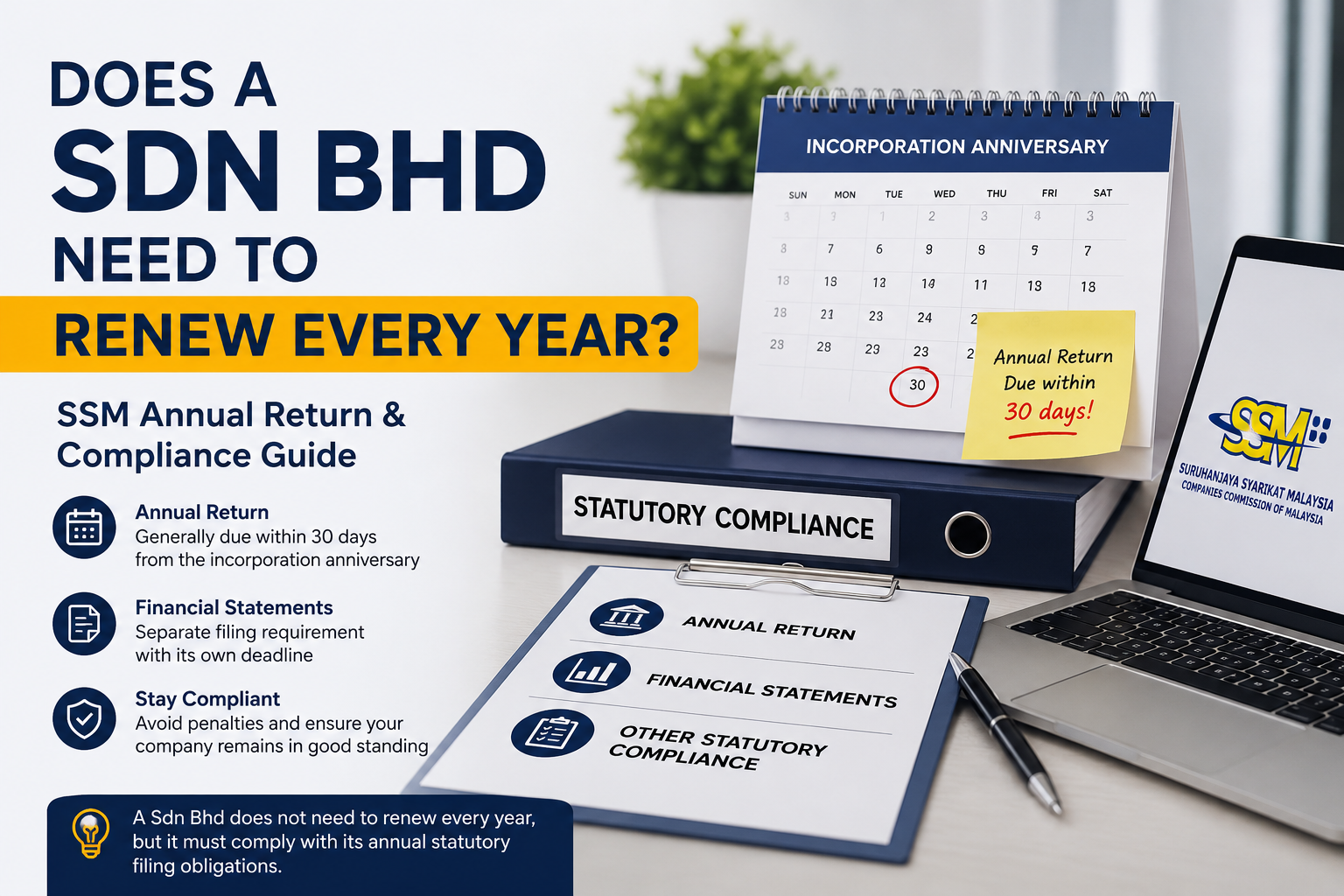
No. A Sdn. Bhd. does not need to renew its company registration every year like a sole proprietorship, partnership or enterprise.
However, a Sdn. Bhd. must continue meeting its annual statutory compliance requirements under the Companies Act 2016. These requirements include lodging the Annual Return with SSM and preparing or lodging the required financial statements and reports.
In other words:
A Sdn. Bhd. does not require annual registration renewal, but it does require annual corporate compliance.
SSM Annual Compliance: Annual Return, Financial Statements and Reports
After incorporating a Sdn. Bhd. in Malaysia, many new business owners assume that the company is fully compliant once the SSM incorporation process is completed.
Not quite.
A Sdn. Bhd. has ongoing statutory compliance requirements under the Companies Act 2016.
Two of the most important annual compliance areas are:
- Lodging the Annual Return with SSM
- Preparing and lodging the required Financial Statements and Reports
These are separate requirements with different deadlines.
Completing the Annual Return does not mean that the company’s Financial Statements have also been filed.
1. Annual Return – When Is It Due?
One of the main annual requirements for a Sdn. Bhd. is to lodge an Annual Return (AR) with the Companies Commission of Malaysia, commonly known as SSM.
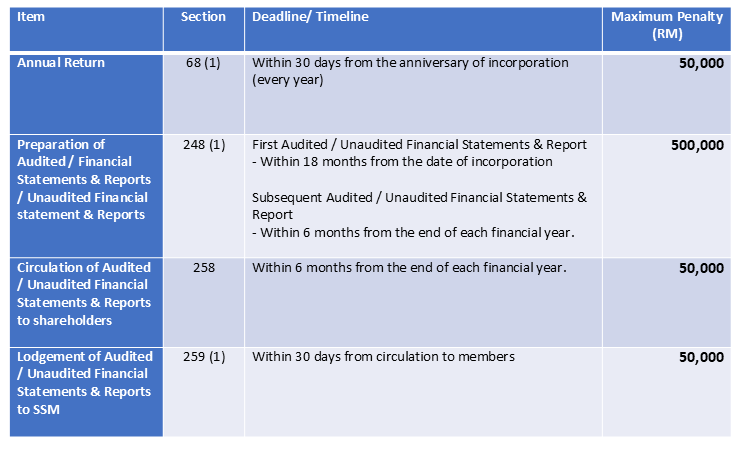
Under Section 68 of the Companies Act 2016, a local company generally needs to lodge its Annual Return within 30 days from the anniversary of its incorporation, subject to the applicable legal requirements.
First-Year Annual Return
The first Annual Return is generally due after the company reaches its first anniversary of incorporation.
For example, if your company was incorporated on:
15 September 2026
Then:
- 15 September 2027 – First anniversary of incorporation
- 15 October 2027 – Generally the deadline for lodging the first Annual Return
Subsequent-Year Annual Returns
After the first Annual Return, the company must lodge an Annual Return every year.
For example:
- 15 September 2028 – Second anniversary
- 15 October 2028 – Generally the deadline for the second Annual Return
- 15 September 2029 – Third anniversary
- 15 October 2029 – Generally the deadline for the third Annual Return
What Information Is Included in the Annual Return?
The Annual Return provides SSM with updated information about the company, including matters such as:
- Business activities
- Registered office
- Directors
- Company secretary
- Members
- Shareholding information
- Other prescribed corporate information
The Company Secretary will normally monitor the Annual Return deadline and arrange the filing on behalf of the company.
Important: The Annual Return deadline is generally based on the company’s incorporation anniversary, not its financial year-end.
2. Financial Statements and Reports
A Sdn. Bhd. must also prepare its Financial Statements and Reports for each financial year and comply with the applicable requirements for circulation and lodgement with SSM.
Depending on the company’s circumstances, the financial statements may be:
- Audited, or
- Unaudited, where the company qualifies for the applicable audit exemption
Financial Statements: Important Deadlines
The timing of the financial reporting process is different from the Annual Return.
Generally, the Financial Statements must be prepared and circulated to members within 6 months from the company’s financial year-end, subject to the applicable requirements.
After circulation, the Financial Statements and Reports must generally be lodged with SSM within 30 days from the date of circulation, subject to the applicable Companies Act requirements.
Therefore:
Financial Statements deadline ≠ Annual Return deadline
A company needs to track both deadlines separately.
First Financial Year
The first financial year begins from the date of incorporation and ends on the company’s first financial year-end.
For example, if a company is incorporated on:
15 September 2026
and its financial year-end is:
30 September 2027
then its first financial period is:
15 September 2026 to 30 September 2027
The company must prepare its first Financial Statements and Reports for this period.
For the first financial year, the financial statements must be dealt with within the applicable statutory timeframe. The company should ensure that the financial statements are prepared, audited where required, circulated to members and lodged with SSM within the applicable deadlines.
What About the 18-Month Rule?
For a newly incorporated company, the first set of financial statements has a specific statutory timeframe for being laid before the company.
In simple terms, the first financial statements should not be delayed indefinitely simply because the company is newly incorporated.
Your accountant, auditor and Company Secretary should coordinate the first-year financial reporting timeline.
Subsequent Financial Years
After the first financial year, the company prepares Financial Statements and Reports for every subsequent financial year.
For example:
First financial year
15 September 2026 – 30 September 2027
Second financial year
1 October 2027 – 30 September 2028
Third financial year
1 October 2028 – 30 September 2029
For each financial year, the company should:
- Close its accounts at the financial year-end.
- Prepare the Financial Statements and Reports.
- Determine whether an audit is required or whether the company qualifies for audit exemption.
- Complete the audit where applicable.
- Circulate the Financial Statements to members within the applicable timeframe.
- Lodge the required Financial Statements and Reports with SSM within the applicable deadline.
What Is the Difference Between a Sdn. Bhd. and an Enterprise?
New entrepreneurs sometimes assume that a Sdn. Bhd. works like an enterprise. They are different types of business structures with different compliance requirements.
| Enterprise | Sdn. Bhd. |
|---|---|
| Business registration is renewed periodically | No annual company registration renewal |
| Renewal of business registration is required | Annual statutory compliance is required (Filing Audited /unaudited financial report) |
| Registration has a renewal period | Annual Return must be lodged with SSM |
| Usually refers to a sole proprietorship or partnership | Separate legal entity incorporated under the Companies Act 2016 |
The business registration renewal requirement generally applies to registered businesses such as sole proprietorships and partnerships. It does not apply to a Sdn. Bhd. in the same way.
In Simple Terms
If you are a new Sdn. Bhd. business owner, remember this:
A Sdn. Bhd. does not need to renew its company registration every year. However, it must meet its annual SSM compliance requirements, including lodging the Annual Return and handling the required Financial Statements and Reports.
Company incorporation is therefore not an annual renewal exercise. It is an ongoing legal and corporate compliance responsibility.
SSM Penalties:
Other than SSM Annual Compliance, What other thing you need to know?
To Understand more on SSM Compliance, you may click on this link for next article.
https://clpc.my/sdn-bhd-ssm-compliance-requirements-in-malaysia/
Frequently Asked Questions
Does a Sdn. Bhd. expire if I do not renew it every year?
No. A Sdn. Bhd. does not operate on an annual registration renewal system like a sole proprietorship or partnership. However, failure to comply with statutory filing requirements may result in penalties, compliance issues or other action under the Companies Act 2016.
When is the Sdn. Bhd. Annual Return due?
Generally, the Annual Return must be lodged with SSM within 30 days from the anniversary of the company’s incorporation, subject to the applicable Companies Act requirements.
Is the Annual Return the same as tax filing?
No. The Annual Return is a corporate statutory filing with SSM. Tax registration, tax computation and tax filing are separate obligations handled with the Inland Revenue Board of Malaysia, also known as LHDN.
Does every Sdn. Bhd. need an audit?
Not necessarily. A company may qualify for audit exemption if it meets the applicable criteria. The company should assess its eligibility based on its financial position, size, activities and the relevant rules in force. (Note: for newly incorporate company, the 1st and 2nd financial year will not be able to enjoy audit exemption, unless the company is dormant)
Who is responsible for Sdn. Bhd. annual compliance?
The company’s directors remain responsible for ensuring compliance. The appointed Company Secretary assists with statutory records, Annual Return filing and other corporate secretarial matters.
How can I check my Sdn. Bhd. compliance status?
You should review the company’s incorporation anniversary, Annual Return filing status, Financial Statements filing status and any outstanding SSM notices. Your Company Secretary can help confirm the company’s current compliance position.
What is the difference between renewing a business and maintaining a Sdn. Bhd.?
Renewing a business usually refers to extending the registration of a sole proprietorship or partnership. Maintaining a Sdn. Bhd. involves ongoing statutory filings, corporate records, financial reporting, tax compliance and other legal obligations.
This article is prepared and professionally reviewed by Pang Cheng Leong , a Malaysian Chartered Accountant, Chartered Tax Practitioner, Licensed Tax Agent and Licensed Company Secretary, with professional experience in accounting, taxation, Audit and corporate compliance.
Professional affiliations: CA (Malaysia), CPA (Australia), CPA (Malaysia), ASEAN CPA), ACTIM
He is the Founder and Managing Director of CLPC Advisors, a Malaysian Accounting, Tax and Corporate Advisory firm providing accounting, tax, advisory and corporate secretarial services to businesses in Malaysia.
The article is intended to provide practical guidance on Malaysian company compliance requirements and is reviewed with reference to the Companies Act 2016, SSM requirements and relevant regulatory guidance.
Last reviewed: August 2026
This article is provided for general information and educational purposes only. It should not be treated as legal or professional advice for a specific company or situation. Regulatory requirements may change, and readers should obtain professional advice where appropriate.