
 Malaysia Corporate Tax Rate: Complete Guide for Sdn Bhd
Understanding Malaysia’s corporate tax rate is essential for every business owner, especially those operating a Sdn Bhd. Proper tax planning helps businesses manage cash flow, maximise available tax benefits, and remain compliant with Malaysian tax regulations.
This guide explains the corporate tax rates applicable to Malaysian companies, SME tax incentives, how corporate tax is calculated, dividend tax considerations, and common questions business owners ask.
What is Corporate Income Tax in Malaysia?
Corporate income tax is a tax imposed on the chargeable income of companies carrying on business in Malaysia.
A company is required to determine its taxable income, calculate the applicable tax payable, and submit the relevant income tax return to the Inland Revenue Board of Malaysia (LHDN).
The amount of tax payable depends on factors such as:
- Type of company
- Paid-up capital and ownership structure
- Chargeable income
- Eligibility for SME tax rates
- Available tax incentives and deductions
Malaysia Corporate Tax Rate (Year of Assessment 2026)
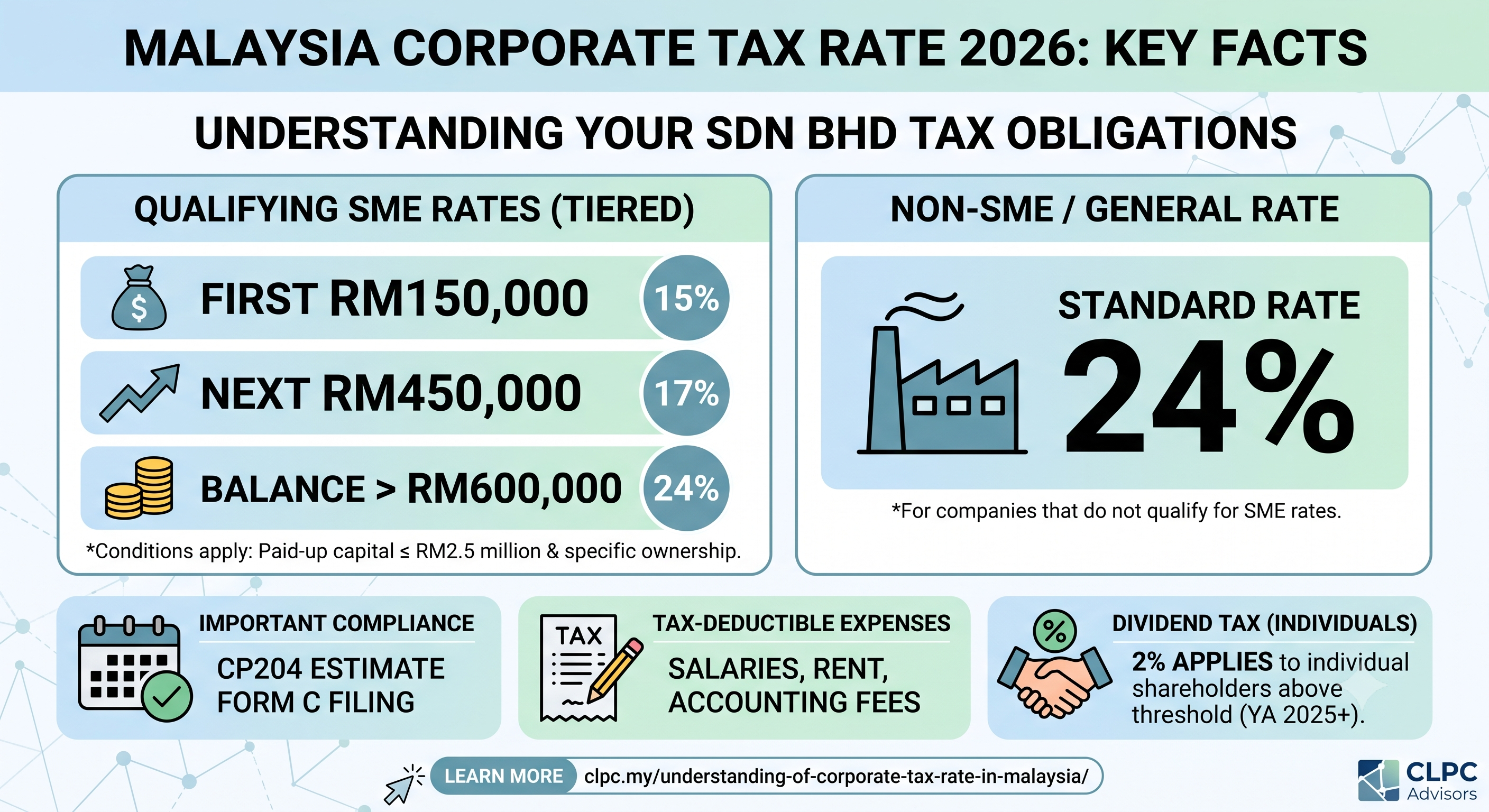
For Malaysian resident companies, the general corporate tax rate is 24%.
However, qualifying small and medium enterprises (SMEs) may enjoy preferential tax rates on the first tiers of chargeable income.
| Chargeable Income | Tax Rate |
|---|---|
| First RM150,000 | 15%* |
| Next RM450,000 | 17%* |
| Balance exceeding RM600,000 | 24% |
*Applicable only to companies that satisfy the SME qualifying conditions.
Companies that do not qualify for SME tax rates are generally subject to the standard 24% corporate tax rate.
Who Qualifies for SME Corporate Tax Rates?
A Malaysian incorporated company may qualify for SME preferential tax rates if it meets the prescribed conditions, including:
- Incorporated in Malaysia;
- Paid-up ordinary share capital of RM2.5 million or below; and
- Meeting the relevant ownership requirements.
However, a company may not qualify if it is controlled directly or indirectly by larger corporations or does not satisfy the required ownership conditions.
Therefore, business owners should review their company structure before assuming they are entitled to SME tax rates.
Example: How Corporate Tax is Calculated
Example 1 – Qualifying SME
ABC Sdn Bhd has chargeable income of RM500,000.
The company may enjoy the SME preferential tax rates:
- First RM150,000 taxed at 15%
- Remaining RM350,000 taxed at 17%
The effective tax payable will be lower compared with applying the standard 24% tax rate.
Example 2 – Non-Qualifying Company
XYZ Sdn Bhd has chargeable income of RM500,000 but does not satisfy the SME conditions.
The company will generally be subject to:
RM500,000 × 24%
What is Chargeable Income?
Chargeable income is not necessarily the same as accounting profit.
A company’s accounting profit must be adjusted according to Malaysian tax rules before arriving at taxable income.
Common adjustments include:
- Non-deductible expenses
- Capital allowances
- Tax incentives
- Business losses brought forward
- Specific tax adjustments required under the Income Tax Act 1967
Common Tax-Deductible Business Expenses
Examples of expenses that may generally qualify for tax deduction include:
- Employee salaries and benefits
- EPF, SOCSO and EIS contributions
- Office rental
- Accounting fees
- Audit fees
- Company secretarial fees
- Professional fees
- Advertising and marketing expenses
- Business software subscriptions
- Insurance expenses relating to business activities
However, deductibility depends on whether the expense is incurred wholly and exclusively in the production of income.
Common Expenses That May Not Be Fully Deductible
Examples include:
- Personal expenses
- Private usage expenses
- Penalties and fines
- Certain entertainment expenses
- Expenses without proper supporting documents
Businesses should maintain proper documentation to support tax deductions.
Corporate Tax Compliance Requirements
A company should be aware of important tax obligations, including:
CP204 – Estimate of Tax Payable
Companies are required to submit an estimate of tax payable and make instalment payments according to the prescribed schedule.
Form C – Company Income Tax Return
Companies are required to submit their income tax return within the prescribed deadline after the end of the accounting period.
Failure to comply may result in penalties and additional tax exposure.
Dividend Tax in Malaysia (2% Tax on Individual Shareholders)
Malaysia operates under the single-tier tax system, where dividends paid by Malaysian companies are generally not subject to further tax in the hands of shareholders.
However, effective from Year of Assessment 2025, a 2% dividend tax applies to certain dividend income received by individual shareholders exceeding the prescribed threshold.
This means business owners should consider not only corporate tax planning but also the tax implications when extracting profits from their companies through dividends.
Business owners should review their overall remuneration strategy, including:
- Salary
- Bonus
- Director fees
- Dividends
to determine the most appropriate approach based on their circumstances.
Frequently Asked Questions (FAQ)
What is the corporate tax rate in Malaysia?
Qualifying SMEs enjoy preferential tax rates on the first tiers of chargeable income, while companies that do not qualify for SME treatment are generally subject to the standard corporate tax rate of 24%.
Does every Sdn Bhd qualify for SME tax rates?
No. A Sdn Bhd must satisfy the statutory conditions relating to paid-up capital, ownership structure, and other requirements before enjoying SME preferential tax rates.
Is dividend income taxable in Malaysia?
Under the single-tier tax system, dividends received from Malaysian companies are generally exempt from further tax.
However, effective from Year of Assessment 2025, certain dividend income received by individual shareholders may be subject to a 2% dividend tax if the applicable conditions are met.
Is accounting profit the same as taxable income?
No. Accounting profit is prepared according to accounting standards, while taxable income is calculated after making tax adjustments required under Malaysian tax law.
Can foreign-owned companies enjoy SME tax rates?
It depends on the company’s ownership structure and whether it satisfies the SME qualifying conditions under Malaysian tax rules.
How can a company reduce corporate tax legally?
Companies can manage their tax position through proper planning, including:
- Claiming allowable deductions
- Utilising available tax incentives
- Planning capital expenditure
- Reviewing business structures
- Maintaining proper accounting records
Professional advice should be obtained to ensure compliance with Malaysian tax regulations.
About CLPC Advisors
CLPC Advisors is a Malaysian professional services firm providing corporate tax, tax advisory, accounting, company incorporation, corporate secretarial, payroll, and business advisory services to startups, SMEs, and growing businesses.
Our team comprises Chartered Accountants, Licensed Tax Agents, and Licensed Company Secretaries who assist businesses in navigating Malaysia’s tax and regulatory requirements.
We believe professional advice should go beyond compliance. By understanding each client’s business objectives, we provide practical solutions that help businesses make informed decisions and achieve sustainable growth.
How CLPC Advisors Can Help
Our tax team assists businesses with:
- Corporate income tax compliance
- Tax planning and advisory
- CP204 tax estimates and revisions
- Form C preparation and submission
- Tax health checks
- LHDN audit and investigation support
- Tax compliance reviews
- Business structuring advice
In addition to tax services, CLPC Advisors provides a complete range of business support solutions, including:
- Company incorporation
- Corporate secretarial services
- Accounting and bookkeeping
- Payroll outsourcing
- Financial reporting
- Business advisory services
Whether you are starting a new business, managing ongoing compliance, or planning future growth, CLPC Advisors is committed to providing reliable and practical professional support.
Last Updated: 12 July 2026
Disclaimer: This article is for general informational purposes only and does not constitute professional tax, legal, or financial advice. Tax laws and regulations may change, and businesses should seek professional advice based on their specific circumstances.